
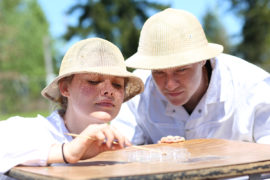
 For three Linfield College science students, research was literally buzzing this spring.
Seniors Tyler Griffin, Alaire Hughey and Renee LaFountain, members of the Animal Behavior biology course, spent five weeks of the semester studying the behavior and ecology of honey bees with Chad Tillberg, associate professor of biology.
Covered from head-to-toe in white cotton bee suits and veils, they spent some afternoons working with hives on the outskirts of campus. This week, they used a smoker to calm the bees, then moved a few dozen to a plastic cooler where the cold slowed their movements even more. Then, using spray adhesive, the students lightly adhered bees to the tips of bamboo skewers for closer viewing.
“That’s the thing about field ecology,” says Tillberg. “It’s really high-tech.”
From there, they dip the bees’ feet in a wide range of varying sugar solutions, looking to see which sweeteners the bees can or cannot detect. They tested eight different sugars at six different concentrations for each sugar. Their goal was to see whether or not honey bees have taste receptors for different sugar types. They found that bees responded to the main sugar components of most floral nectars — fructose, glucose and sucrose — as well as maltose, a disaccharide of glucose. The bees did not respond to other sugars, nor to the artificial sweetener saccharin.
During these labs, students have had hands-on experience working with bee colonies and have become comfortable around the hives as well.
“It’s kind of weird to be in a swarm of buzzing bees,” said Hughey, describing the hypnotic sound. “I actually took a nap when we were waiting one day. I just lied down in my suit by the hive.”
Tillberg, who has kept bees at his home on and off for 10 years, hopes to have a honey harvest in August. With the prolonged cold weather this year, warm foraging days have been scarce and Tillberg has been feeding the bees a sugar solution.
“I’m interested to see what kind of year it’s going to be for bees because it’s been the wettest winter and spring in 75 years. I’m not even sure what normal is anymore,” said Tillberg. “There are a few things in flower now and producing pollen so they’re also out there looking, but they’re not quite in full summer-swing yet.”