
Reprinted with permission of the News-Register.
By Starla Pointer October 2, 2017
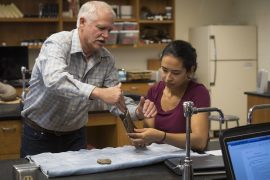 Linfield College senior Addy Ahmasuk spent a productive day floating on the Yamhill River. She came home with a section of mammoth tusk more than a foot long and about 50 million years old.
Dark brown with age, the tusk was propped up against a half-buried log, so it looked like the stub of a branch. It was almost unnoticeable, said Mike Full, an avid local fossil hunter.
Full, a former police officer, founded the Yamhill River Pleistocene Project. He leads frequent fossil hunting trips with students, such as the one Ahmasuk and her Linfield classmates took last month.
Most people would have dismissed the well-camouflaged tusk, if they’d noticed it at all, he said.
But Ahmasuk, a biology major from Alaska, took the time to investigate the object. She was following Full’s advice to “touch EVERYTHING, go slow, look close.” And she was rewarded with an amazing find.
The tusk displays the compound curve associated with the mammoth, which grazed what is now Yamhill County in the Pleistocene period, between 12,000 and 2.5 million years ago. Tusks from mastodons, which were more common then, feature simple curves.
Ahmasuk continues to wonder about the mammoth that grew the tusk. Was it alone or part of a herd? How did it die? How did it live? How far did it roam?
What about two other pieces of fossilized bones she found? The pieces fit together, but aren’t identifiable as being from any particular animal.
“Fossil fever is a disease,” Ahmasuk said happily. “Now I’ve got it.”
The senior from Alaska is among students in the “Evolution” course, taught by John Syring, associate professor of biology. It’s required for biology majors.
“Evolution is a unifying theory,” Ahmasuk said, explaining the importance of the course.
“It’s the reason why things are as they are,” said classmate Hayden Rock, a biochemistry major focusing on genetics.
Professor Syring, also known to have “fossil fever,” has taken his students on several of Full’s excursions on the Yamhill. He made a major find of his own.
It was among the old bones Full delivered to Syring’s classroom last week. All are part of the Yamhill County Pleistocene Project’s collection, which is dedicated to public and educational purposes.
“You gotta see this!” Full said, unwrapping the large, heavy fossil Syring found. “A bison horn!”
The professor and students gathered around to admire the object, which had been meticulously cleaned.
The Linfield class found about 20 objects that day, ranging from small shafts of bone to an arrowhead to large pieces such as the bison horn, the mammoth tusk and a horse vertebrae. It was a good haul, Full said.
Every year, more fossils wash down the river or are exposed by the shifting pebbles. The fossils may have been buried only a few feet away last year, or they may have moved miles during winter storms. Next year, the same stretch of riverbed may yield more fossils — or none.
“We floated slowly down the river and stopped and searched a lot,” said Rock, a senior from Corvallis. His own search revealed a hollow, fossilized bone that resembles a small flute. It may be from an elk.
When the boat stopped, students stepped into the shallow water. Some snorkeled, Ahmasuk said, although the muddy water made it difficult to see much.
With or without snorkels, they felt around in the water and mud, as Full had advised. Squishy things might be wood or other plants.
Both rocks and fossils were unyielding and felt similar at first, Rock said. He and the others quickly determined how to tell the difference.
Another senior, Sahaj Wanchu, said they had to pay close attention. “It’s a cool experience, to have to really look,” he said.
After several hours of searching, Wanchu found a bone fragment. He couldn’t identify the type of animal, though.
His big find was not a bone at all. It was an arrowhead, which he spotted lying in the open on the bank.
“It was clearly not a (natural) rock,” he said. “It was bright red and shaped, a couple inches long.”
Trisha Kuehn, a biology major from Hillsboro, found the horse vertebrae partly buried in sand and water. At first, she said, she wasn’t sure if it was from a bison, a camelid or a horse.
“I hoped it wasn’t bison,” she said. “They’re too common.”
She was delighted that it turned out to be equine.
Full said the mineralized vertebrae came from an ancient horse probably about the size of today’s American Quarter Horse. The species evolved here in the Pleistocene age, then went extinct.
Horses were reintroduced to North America much more recently.
It’s a lovely fossil, he said. “You can see the nerve channels,” he noted, guessing that the bone came from the area near the base of the horse’s neck.
Kuehn said she’s also wondering about the life of the horse that left its vertebrae.
“I can’t imagine the landscape back then,” she said, “but I know this will help us track horses’ movements.”