
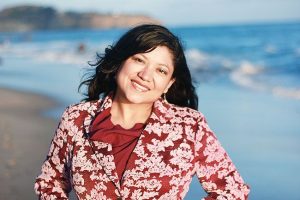
 Reprinted with permission of the News-Register. • By Tom Henderson, March 29, 2018
Writer Reyna Grande spent much of her childhood living in cardboard homes that turned to mush in the rain.
Scorpions crawled along the wall. The sight of them haunted her. “I felt I had a kind of scorpion inside me that was stinging my heart again and again,” Grande said.
As she prepares for a visit to McMinnville, the author wants her readers to feel that sting — the pain of a 4-year-old girl separated from her parents.
Her mother left their village in Mexico to work in the United States; her father was already there. They were unable to enter the country legally, but they had to choose between breaking the law and feeding their children.
Meanwhile, Grande and her brother and sister lived with their strict, sometimes even cruel, grandparents. They didn’t see their parents again until Grande was ready for middle school — a total of eight years.
“That’s not uncommon at all,” Grande said. “Sometimes parents never come back. Over the years, it has become more common as it’s become harder and harder to cross the border. Parents are not able to go back for their children. That’s why we have seen so many unaccompanied minors.”
She added the length of separation varies from family to family. “It could be a few months, or it could be many years, or it could be forever,” she said.
Grande’s 2013 memoir “The Distance Between Us” chronicles her family’s lives as undocumented immigrants. Her book is the focus of a series of events in the MacReads program next month.
The author said she hopes her book helps people understand what it means to be undocumented in the United States, especially at a time when there are increasingly hostile attitudes toward immigrants.
“I think the book captures the experience of an immigrant family, but it’s written from my point of view as a child,” she said. “It’s a slightly different perspective on immigration. It’s mostly about child immigration. It focuses on the effects of immigration and family separation.”
The eight years she spent apart from her parents was scarring, Grande said. “There was an emotional distance that was created,” she said.
The first half of the book tells her story as a young girl in Mexico. “The second half of the book deals with my border crossing and reuniting with my father, and realizing we had become strangers to each other,” said Grande.
——
Grande, who lives near Sacramento, published her first novel, “Across a Hundred Mountains,” in in 2006. It was also mostly autobiographical as well, with a few exceptions.
The story follows a girl who leaves her hometown in Mexico to search for her father. Grande started writing the book to explore her experience of being separated from her own father. “It was more about what could have happened,” she said. “I was exploring that fear that all children have that their parents will leave. They will cross a hundred mountains and never come back.”
Grande’s second novel, “Dancing with Butterflies,” was published in 2009. An excerpt from the book was published a year earlier as a short story under the title “Adriana” in “Latinos in Lotusland: An Anthology of Contemporary Southern California Literature.”
Grande took up writing as a sort of therapy when she was 13, three years after she crossed the border into the United States.
“I was struggling to adapt to my new home,” she said. “I was dealing with the changes in my life. I started writing about them. I didn’t know how to express my feelings. I wrote about all the things that were happening to me and how I felt about them.”
When she was 19, an English instructor at Pasadena City College inspired her to pursue writing as a career. Grande eventually earned a degree in creative writing from the University of California at Santa Cruz.
“When I graduated from college, I realized creative writing hadn’t prepared me for a real job,” Grande said. “I went to newspapers to apply for work. They told me my creative writing degree was useless.”
Critics disagreed. She went on to receive an American Book Award, El Premio Aztlán Literary Award and International Latino Book Award. In 2012, she was a finalist for the National Book Critics Circle Awards, and in 2015, she was honored with a Luis Leal Award for Distinction in Chicano/Latino Literature.
Her works have been published internationally in Norway, South Korea and Mexico.
——
A sequel for “The Distance Between Us” is already in progress: “A Dream Called Home” is due to hit bookstores in October. “It’s about the search for belonging and the search for a place to call home,” she said.
After all these years, Grande said she thinks she has finally come home in her own life. “I think I have managed to create a home,” she said. “My writing has been my way of building that home for myself.”
She doesn’t typically work on a set schedule. “I wish I did,” she said. “I wish I was more disciplined. I tend to be more of a binge writer. I think about what I’m going to write, and when the moment comes, I just sit down and print it all out.”
Despite being in touch with her cultural heritage, Grande admitted she is not quite as in touch with her native language.
“I write in English,” she said. “My Spanish is mostly conversational Spanish, but it’s not good enough for me to write in Spanish without having to grab a dictionary every other minute.”
Her upcoming appearances in McMinnville leave her feeling a bit intimidated. A big part of making a living as a writer is traveling and speaking. Grande said public appearances are difficult for her, being bashful by nature.
“I think for me, being an introvert, I’ve been forced to create a public persona because I’m perfectly comfortable just being alone writing all day,” she said.
Nevertheless, she said, she enjoys talking with people about what it means to be an immigrant. “I’m really grateful for this opportunity as an immigrant. Growing up, I often felt invisible and voiceless. Now, thanks to my writing, I’ve been able to feel the opposite.
“They’re giving me a platform and a microphone. It feels good.”
——
The last half of her childhood was rough, Grande said. She went to middle and high school in northeast Los Angeles in a mostly Latino neighborhood. It wasn’t any kind of culture shock that bothered her, she said.
“What was difficult is that the Latino kids at school, many of them were born here,” she said. “They weren’t very kind to immigrant kids.”
She never forgot that division. “That creates some tension in the Latino community,” Grande said. “We’re so diverse, but what we lack is Latino leaders. We’re not all together all that cohesive. We’re not really coming together to support each other.”
Grande added she often felt excluded by her peers. “I also felt very lonely because I was dealing with some very difficult things at home,” she said. “I felt I couldn’t tell anyone what was going on at home. I felt like I was the only kid going through these things.”
Turns out, she was not.
“People tell me that was their experience, too,” she said. “It’s kind of nice to see I wasn’t alone. Maybe if I was able to share more of my experiences, I would have found other people to support me.”
Now, at least, Grande is able to be there for others.
“I get e-mails from middle and high school students,” she said. “They tell me they were able to connect and find inspiration, and found a way they can relate to their own experience in a book.”
READINGS AT THE NICK: Award-winning novelist and memoirist Reyna Grande will read from her works on Thursday, April 26, at 3 p.m. in the Austin Reading Room in the Nicholson Library at Linfield College. Grande will also present a lecture at 7 p.m. in the Richard and Lucille Ice Auditorium in Melrose Hall at Linfield. The reading is part of the “Readings at the Nick” series and both events are free and open to the public. For more information, contact Sonia Ticas at sticas@linfield.edu or 503-883-2367.