
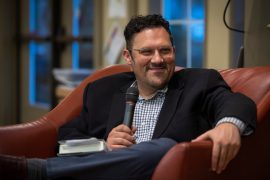
 “The Fire Is Upon Us: James Baldwin, William F. Buckley Jr., and the Debate over Race in America,” the latest book by Linfield political science professor Nick Buccola, won Literary Arts’ Frances Fuller Victor Award for General Nonfiction on May 2.
“I am so honored to have ‘The Fire Is Upon Us’ recognized in this way by Literary Arts, an organization devoted to the idea that writing can change the world,” Buccola said. “To further advance that idea, I am pleased to announce that my central use of the monetary prize for this award will be to establish a scholarship for students on the theme of writing truth to power, which will invite writers to address central issues of the day, including resisting authoritarianism, advocating for racial justice and displacing toxic masculinity.”
“This book would not exist without the collaborative efforts of Linfield students and I look forward to supporting our students through this scholarship,” he said.
Buccola’s book dives into the 1965 debate between James Baldwin and William F. Buckley Jr., a key historical event during which these two prominent figures focused on understanding race and American power. The book has also garnered national attention with recognition on prominent book lists, such as a New York Times Book Review Editors’ Choice.
“Buccola’s incisive and critical commentary enlivens these men and their ideas, as well as the implications of their positions, demonstrating all the ways this debate remains relevant still,” Literary Arts judge Adam M. Sowards said. “’The Fire Is Upon Us’ delivers what the best historical writing does: a palpable sense of the past itself and its lingering significance on our lives today.”
Literary Arts is a nonprofit literary organization focused on honoring Oregon writers, engaging readers and inspiring future generations by promoting great literature.
Buccola joined Linfield faculty in 2007 and is currently the Elizabeth and Morris Glickman Chair in Political Science. He has also authored other published works concerning political theory and public law, such as “The Political Thought of Frederick Douglass,” “The Essential Douglass” and “Abraham Lincoln and Liberal Democracy.”