

Story and photos courtesy of the Yamhill County News-Register. Originally written by Starla Pointer. Published online Jan. 23, 2023.
In just a few weeks, associate chemistry Professor Megan Bestwick and her students at Linfield University will be back to studying mitochondrial DNA. This semester they will have new space to collaborate as they conduct research, as the new W.M. Keck Science Center opens.
The science facility features a new building connected to two remodeled ones, Graf Hall, originally built in 1960, and Murdock Hall, built in 1982.
The project, which is expected to be fully complete within a couple weeks of the start of the spring semester, doubles the previous amount of space devoted to chemistry, physics and other sciences.
It includes a dedicated wine lab for Linfield’s popular Wine Studies program, and areas for students to study solo or in groups, as well as a multipurpose room that can be used for banquets and gatherings or divided into three smaller rooms.
For Bestwick, the best parts are the collaborative research labs filled with numerous specialized hoods — ventilated spaces akin to the hood over a kitchen range — for conducting experiments.
“Look at all the hoods! They dramatically expand our space,” she excitedly told visitors on a tour of the new space Wednesday.
In her mind’s eye, she saw students standing at each hood, researching the proteins in mitochondrial DNA and how mutations might be linked to childhood diseases or neurological conditions such as Alzheimer’s, Parkinson’s or bipolar illness. A team of those students might someday discover a key that could bring more hope to patients.
Bestwick is excited about the new hoods and new spaces in the W.M. Keck Science Center.
The new science facility will be much more than a building, she and other university officials said. It will mean opportunities to expand knowledge for students, and perhaps the world.
“We’re super proud of this,” said Kelly Williams Brown, media and public relations manager at Linfield.
In addition to learning and research, it will help attract high-tech industries looking for workers, she said. “It’s a resource not just for Linfield, but for the entire community.”
Linfield has been planning for the new science center for two decades, said Lisa Petterson, principal architect for SRG Partnership, who led the tour. Ribbon cutting for the Keck center is planned for 4:30 p.m. Friday, Feb. 24. It will coincide with the Oregon Nobel Laureate Symposium, which will feature a lecture by science laureate Bill Phillips on Feb. 23.
Discussion about the project started in 2002, when the school was still called a college. Planning geared up in 2014, when Linfield officials toured science facilities at other colleges and universities.
“We imagined everything we could imagine, then decided what we could do,” she said.
After extensive fundraising, Linfield broke ground for the new science center in July 2021 in the middle of campus, adjacent to Linfield Avenue.
To make room, the school tore down one of its older buildings, the 1939 Mac Hall, built as a dorm and used, in recent years, for computer science and other programs.
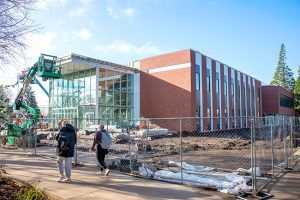
Like Mac Hall, the new building features brick to match other facilities on campus. It has a more modern look, though, with clean lines and plenty of windows on each side. The main entrance to the east opens into a two-story glass lobby with a variety of seating for students who are studying or working together.
The glass walls and windows will bring in more than sunlight, Petterson said. Perhaps passersby will see students pursuing research and learning — and come inside to take a science class themselves, as well.
Each of the new building’s two above-ground floors contains laboratory classrooms and easily accessible storage areas. Some are set up specifically for chemistry; some, such as one with a beam from which gravity experiments may be suspended, are for physics.
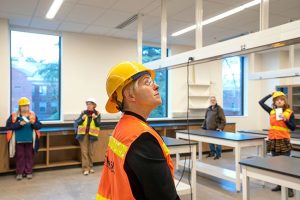
Like classrooms throughout the complex, the rooms are equipped for projecting information onto a wall for the whole group to see. The multipurpose room has large-screen televisions that serve the same purpose.
“That’s essential for today’s teaching,” Petterson said.
On the main floor, a space is dedicated to wine studies. During the tour, McMinnville Mayor Remy Drabkin, a winemaker and Linfield graduate, peered into the coolers that line one wall, ready to receive a pallet of grapes. She would have loved to have a facility like that when she was a student, she said.
The room opens to a “brewing patio” that can be used for both wine studies and Professor of Chemistry Brian Gilbert’s “Art and Science of Brewing” class. He said the interdisciplinary course teaches chemistry through beer-making, something that’s near and dear to the hearts of many college students.
The basement also includes classroom space, but the rooms aren’t yet fitted out. They are waiting until they are needed, Petterson said.
The new building is connected on each level to Graf Hall, which still contains a lecture hall at its center. Graf’s footprint has been expanded to the north, though, with the addition of the multipurpose room facing the university’s main quad, bounded by Melrose on the north, Taylor and Riley to the west and the east.
The glass-enclosed space can accommodate up to 120 at banquet seating, with doors opening to a patio for social hour; a catering kitchen is attached. If roll-up walls are pulled down, the room becomes three classrooms, each of which can hold 32 students.
“We didn’t really have a space like this. I expect it to be used frequently,” said Scott Nelson, Linfield’s associate vice president for strategic communications.
Upstairs in Graf are more specialized lab/research spaces where students will work. The labs are in the center, with professors’ offices around the perimeter, making supervision easy, Petterson said.
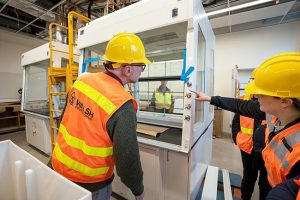
The labs are fitted out with casework — benches and cabinets — Linfield acquired from Dow Chemical. The company had planned and started equipping a local plant, but stopped the project; Linfield was able to make use of the equipment it had started to install but never used, Petterson said.
In the labs, contractors also reused some of the original glue-laminated wooden beams they discovered in Graf.
“The drawings said this building was pre-cast concrete throughout, but the second floor was wood,” Petterson said. “It’s beautiful to have these beams, these pieces of the past.”
Graf, in turn, connects to Murdock, which also underwent some remodeling as part of the Keck project, with more in the future.
Two chemistry classrooms in Murdock were refitted for biology courses. Some offices were combined to create more classroom space. An all-gender restroom was added.
Across the three buildings, the new Keck Science Center includes 89,000 square feet of space — twice the amount previously devoted to science at Linfield, Petterson said.