
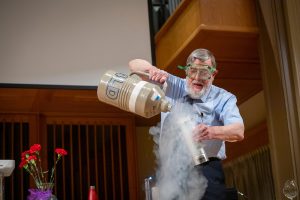
 Lectures on supercooled atoms may not top the average elementary school student’s wish list. But Bill Phillips, who won the Nobel Prize in physics in 1997, knew what he was doing when he reserved the first row of Richard and Lucille Ice Auditorium for kids.
Part of the Oregon Nobel Laureate Symposium at Linfield University, Phillips’ Thursday-night keynote speech explored using lasers to trap atoms via the Doppler effect and speculated on the future of quantum computing. It also made a great deal of noise.
“Remember: this is quite dangerous and you cannot do it at home — unless you become a scientist!” he said.
An hour later, the kids in the front row (and the near-full audience of students, faculty and community members behind) had seen him pour billowing clouds of liquid nitrogen that raced and hissed across the stage, shatter a carnation into tiny pieces, levitate magnets and blow a garbage can almost to the ceiling of the auditorium. He ended by throwing each of his front-row guests a frozen balloon-turned-frisbee, which sizzled and reinflated as it reached their warm hands.
“Now — are there any questions?” he asked, and almost every kid in the room stood up and got in line.
“If you got into a bath of liquid nitrogen, how long would it take you to die?” a boy inquired.
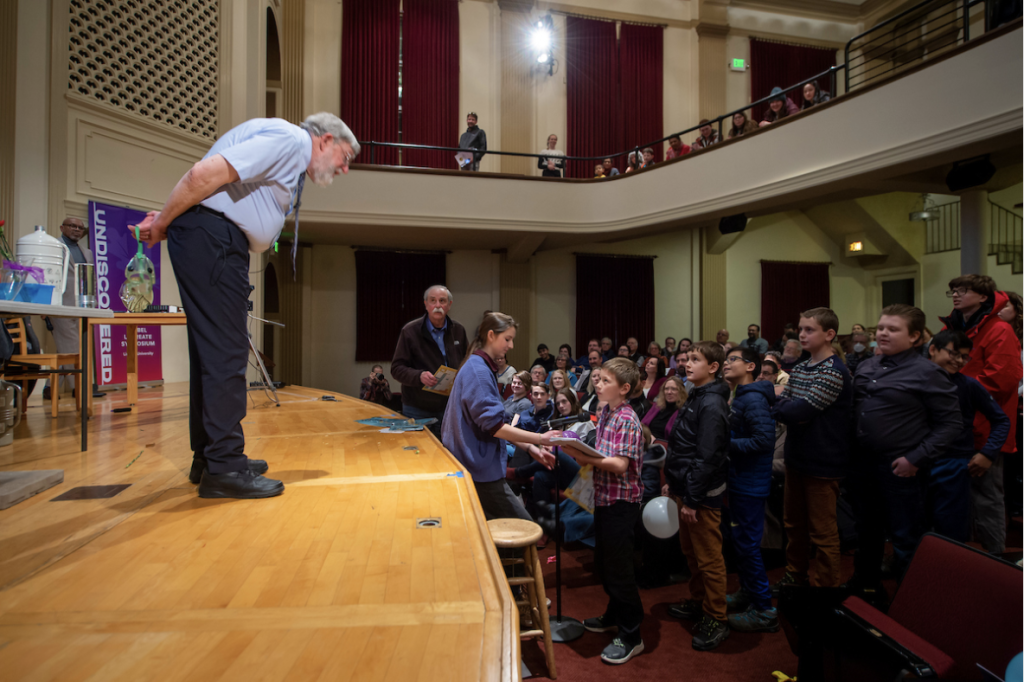
Phillips laughed. “Some experiments, if we already know what’s going to happen and they’re just not a good idea, we don’t do them,” he said, but went on to explain that he could, in fact, touch liquid nitrogen very briefly because the extreme heat of his hand made it boil upon contact. With that, he poured a boiling stream on his hand and tossed it toward the audience.
Scheduled talks for local high school and community college students were canceled due to weather. The cancelation, however, led to an unexpected gift: a student had the chance to privately dine with Phillips and Wineland.
“We ended up having lunch, just the four of us together, talking about our heroes in science and how the laureates themselves were intimidated by those people too,” said Professor Michael Crosser, who was integral in organizing the symposium. “Dr. Phillips and Dr. Wineland were both fantastic people, humble and really great.”
Established at Linfield by President Emeritus Charles Walker in 1985 after a major gift from an anonymous donor, the symposium series has drawn 23 Nobel award winners to the McMinnville campus. Past speakers include Elie Wiesel (Nobel Peace Prize, 1986), Linus Pauling (Nobel Prize in chemistry, 1954; Nobel Peace Prize, 1962) and Oscar Arias (Nobel Peace Prize, 1987), among others.
For his part, Phillips said that Linfield held a special draw for him — it reminded him of his own undergraduate years at the 1,600-student Juniata College in Huntington, Pennsylvania.
“I came from a small liberal arts college environment, so the atmosphere here is very familiar to me,” he said. “The kind of interactions that students have with professors in that environment is something I treasured in my undergraduate years and something I see happening here as well.”
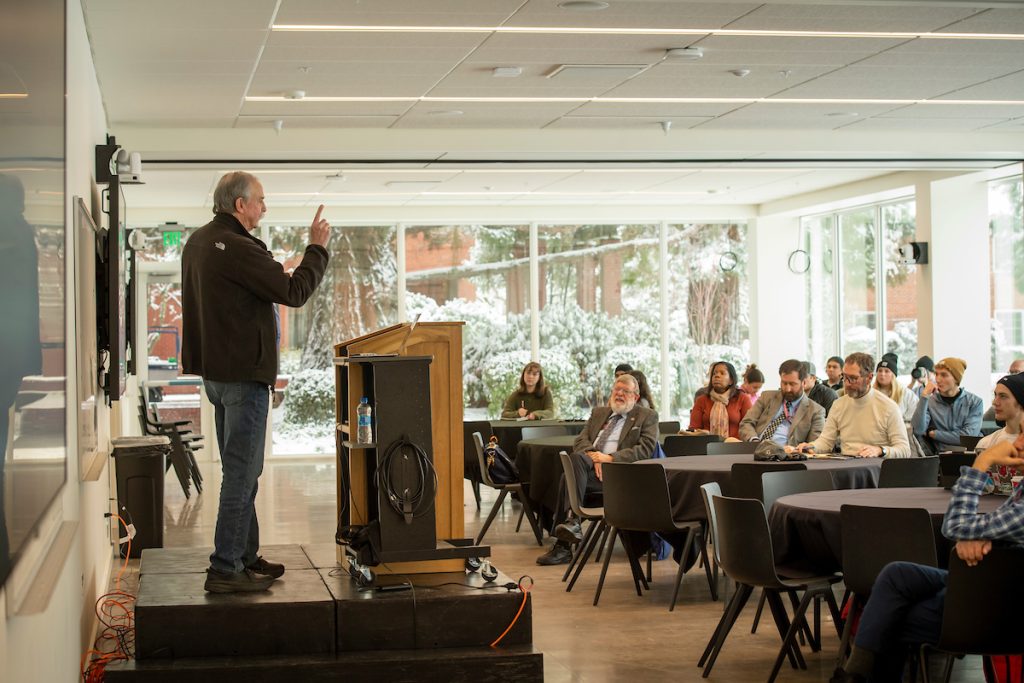
At the science center ribbon-cutting, he hailed Linfield’s commitment to undergraduate research.
“I participated in research as an undergrad and I heartily agree in trying to get as many students as possible involved in research. It meant a lot to me and really set me on the path for my career,” he said.
Self-professed “science geek” and Linfield President Miles K. Davis expressed gratitude to the many university departments who worked for more than a year to bring students a once-in-a-lifetime experience.
“These gatherings give Linfield students the opportunity to converse directly with some of the most brilliant minds on earth,” Davis said. “Seeing our physics majors sitting in small groups talking directly with two of the world’s greatest living physicists was extraordinary.”[Best_Wordpress_Gallery id=”144″ gal_title=”Oregon Nobel Laureate Symposium 2023″]