
 For the 14th year in a row, Linfield University was included in The Princeton Review Guide to Green Colleges, which celebrates colleges and universities with “programs, policies and practices related to sustainability and the environment.”
For its most recent ranking, Princeton Review used more than 25 data points derived from surveys of college administrators and students at nearly 600 institutions in 2023-2024. (See more about their methodology). The publication has included Linfield among its best green colleges list since its inception in 2010.
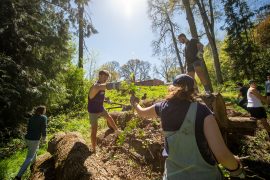
It was especially welcome news to environmental studies professor William Fleeger. Environmental studies students and faculty have spent a decade, in partnership with Facilities Services, restoring and stewarding the Cozine Creek Natural Area on the McMinnville campus.
“We’ve planted native species and done a great deal of work removing invasive species,” he said. “We’ve done experimentation with different treatment types — manual removal, mechanical removal, chemical removal — in order to get a sense of what was most effective in controlling invasive species.”
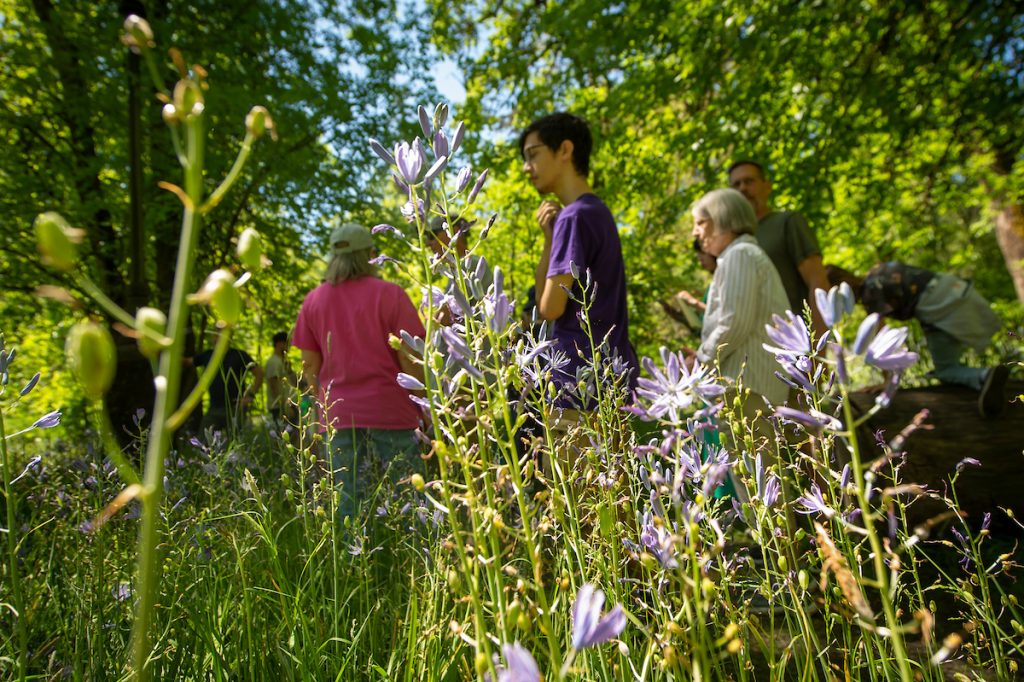
He said that while the true number is incalculable, faculty and students have spent thousands of hours on the effort. Each year, the public is invited to experience the natural history of Cozine Creek’s camas patches during the annual Camas Festival, put on in partnership with the Confederated Tribes of Grand Ronde and the Greater Yamhill Watershed Council in May when the camas lilies bloom.
A key partner, Fleeger said, is the facilities services department under the leadership of Allison Horn, associate vice president. For her part, Horn said it’s a wonderful partnership.
“We always attend their final presentations and offer support in whatever ways we can,” she said. “They do so many amazing things — restoring native plants, re-seeding the camas patches — and they’ve put together a comprehensive plan that builds on itself year after year. It’s wonderful to see their efforts expand.”
Horn’s team has also been central to Linfield’s commitment to sustainability. Among her proudest accomplishments, she said is “saving a ton of water — we’re talking 360,000 gallons a month on athletic fields alone during irrigation season.”
For context, an Olympic-size swimming pool has about 660,000 gallons of water.
That conservation, she said, was possible through an investment in multiple systems, including smart controllers, time-based watering and use of weather stations on campus and elsewhere.
“The systems use weather forecasts, current conditions and historical data to make sure they’re not over-watering, and they irrigate about 90% of McMinnville campus lawns,” she said.
Over the past several years, there has also been a major focus on reducing dining hall food waste, led by Javier Lopez, dining services general manager with Sodexo. Eliminating trays — though students may still get as much food as they want — reduced food waste by at least 35%. Much of the remaining food waste doesn’t go into landfills, but rather to Chapul Farms in McMinnville, which receives more than 150 pounds per week that can be used to feed chickens.
Bulk condiment dispensers replaced disposable, individual containers on tables. Some solutions are cutting-edge — the Ecolab Apex Dishwashing System combines technology and products designed to save water and energy. Others are timeless, including using natural light within the dining spaces and offering vegetarian and vegan options that require fewer resources to produce.
Other efforts include EV charging stations on both campuses, possible through a PGE 2022 Drive Change Fund Grant.
For his part, Fleeger said that student work in Cozine Creek is about more than restoring a once-central piece of the campus — it’s about creating a lifelong connection to the land.
“Once you’ve spent time with the land, investing in it, it’s hard not to think of that place as being connected to you,” he said.
Read more about Linfield’s commitment to sustainability at linfield.edu/sustainability.