
Nursing students learn to help people “live until they die”
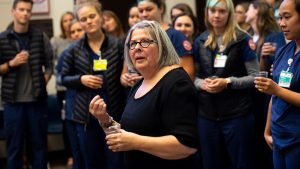 Senior nursing students at the Linfield-Good Samaritan School of Nursing participated in the inaugural symposium exploring palliative and end-of-life nursing care.
The first Dr. Jan Selliken Life Transitions Nursing Symposium was held on Wednesday, October 3rd. 76 students and 14 nursing faculty participated.
“As we all know, our population is living longer with more chronic diseases, so we do more palliative care,” said Julie Fitzwater, assistant professor of nursing.
Palliative care is specialized medical care for people with serious illness. Nurses are part of the interdisciplinary team assisting patients and families to find relief from the symptoms and stress of life-limiting illness; the goal is to improve the quality of life.
The symposium is part of the third nursing semester clinical course focused on the care of patients with acute illnesses. The all-day symposium focused not just on patient care, but also on nurse resilience and self-care. Students prepared for the clinical day by completing online educational modules from the End of Life Nursing Education Consortium (ELNEC) for undergraduate students and researching medications used in end of life care.
The symposium opened with an introduction to palliative care by Melissa Robinson, associate dean of nursing. Robinson emphasized the importance of helping people “live until they die” by focusing on personal goals of care.
In groups facilitated by clinical faculty members, students participated throughout the day in an unfolding case study of a patient at the end of life. Students also created a personal plan for resilience in their own lives and nursing practices.
Student Dmitriy Flato ’19 thought the symposium was “a great day.”
“I learned so much,” he continued. “It’s something that opened my heart to see how the patient might feel, how the family might feel.”
Haleigh Woods ’19 concurred. She said the most important things she learned that day was “communicating with family members, building bridges with family members.”
She advised students who would be attending the symposium in future to “bring some tissues. It’s very informative. Just be prepared, you have to be able to be professional and maintain your emotions.”
She continued, “I felt really connected and proud to be a Linfield student.”
The symposium was named for professor emerita Selliken in honor of her exceptional scholarship and work focused on life transitions. Selliken, an expert in palliative and hospice care, has written books on the subject; she developed the Transitions in Health and Illness course for the nursing curriculum.
“She calls it being a midwife to the birthing and dying,” Fitzwater said. “Students are seeing the difference between when we’re trying to save someone’s life versus when we’re trying to help someone leave this life with comfort and support.”
Selliken presented a talk at the end of the day closing with a ritual ceremony toasting those who have died before us. She was unaware that the symposium would be named in her honor.
Paul Smith, associate dean of nursing, said as he presented Selliken with a certificate, “For our grateful recognition of your scholarship and teaching to help the community, as scholars and humans, to understand and appreciate the true work of birthing and dying, we dedicate this educational symposium to you.”